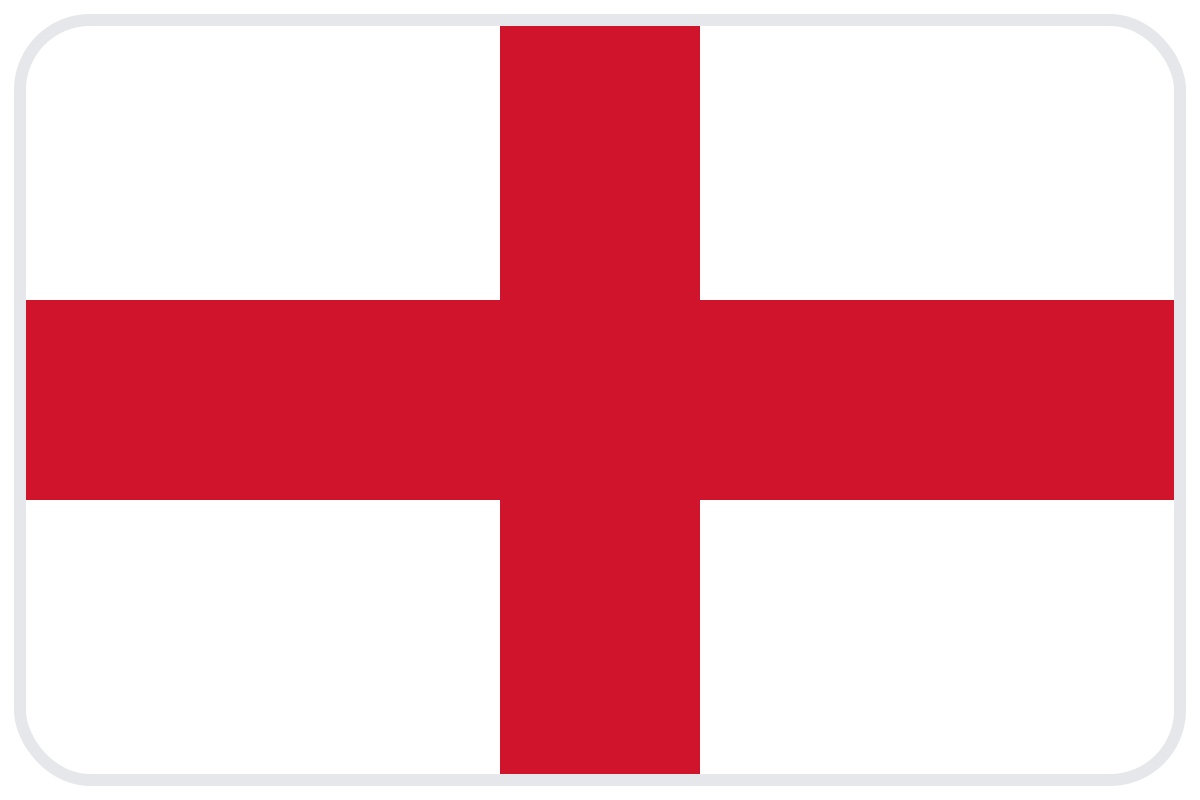
| Manager | Thomas Tuchel |
| Founded | 1863 (age 163) |
| FIFA Ranking | 5th Place |
| UEFA Ranking | 6th Place |
| Best Finish | Champion (1966) |
| Group 2026 | L |
The Quest of the Three Lions: Analyzing Projections and Tactics
The international football community is preparing for an event of unprecedented scale, and attention remains firmly fixed on historical powerhouses. Navigating a 104-match schedule in a 48-team format demands a perfect synthesis of tactical discipline, physical endurance, and world-class squad depth. For years, the England team has been knocking on the door of global supremacy, suffering cruel setbacks in the final stages of major tournaments. Today, driven by evolving tactical management and a golden generation of attacking creators, the British squad seems armed to end several decades of drought. The evaluation of England's 2026 World Cup winner odds offers a deep analytical look at how models perceive the maturity of this group.
For observers scrutinizing global data, England's 2026 World Cup winner odds represent a fascinating analytical proposition. Currently valued around +650, the team boasts a squad brimming with talent playing in the world's most demanding domestic league. Unlike previous versions of the national team, which often collapsed under the weight of media expectations, this modern group operates with clinical pragmatism. Understanding the true potential of this team requires analyzing their tactical evolution, their ability to dictate the pace in midfield, and the stability of their competitive performances.
Analytical Positioning: The Main Challenger
The top third of the global ranking is incredibly dense. With Spain and France acting as co-favorites, the English national team occupies the critical position of the main challenger. England's 2026 World Cup winner odds translate to an implied victory probability of 13.3%. This evaluation demonstrates immense respect from global statistical models, recognizing that the squad possesses the pure talent needed to dismantle any defensive structure on the planet through its creative overloads.
To adequately contextualize England's 2026 World Cup winner odds within the global market, it is essential to compare their squad depth with that of their immediate rivals.
Nation | Initial Evaluation | Implied Probability | Main Tactical Strength |
France | +500 | 16.7 % | Transition speed and depth |
England | +650 | 13.3 % | Midfield creativity and versatility |
Brazil | +800 | 11.1 % | Individual explosiveness |
This comparative table highlights the team's structural advantage: the versatility of its midfield. By having profiles capable of playing as deep-lying playmakers, intense box-to-box midfielders, or wide playmakers, the coaching staff can change the team's animation during the match without making any substitutions. This flexibility justifies the robustness of England's 2026 World Cup winner odds despite the inherent pressure of the tournament. For a cross-sectional perspective, the analysis of the potential of the Brazil team allows for an evaluation of different approaches in offensive animation.
Group L: Rivalries and Top Seed Strategy
The British squad's initial journey is in Group L, where a highly anticipated rematch against Croatia looms, alongside Ghana and Panama. This European clash is the pivotal encounter of this quartet. Historically, the experience and methodical rhythm of the Croatian midfield have posed serious problems for the English.
However, the current version of the British squad possesses the athletic energy and pressing intensity needed to overwhelm aging opponents.
The objective of securing first place is paramount. Analysis of flows on platforms like Dexsport demonstrates that dominating Group L is absolutely vital, as the tournament's expansion means surviving eight matches with maximum energy. Understanding the dynamics of mathematics in a single-elimination tournament helps comprehend why securing a favorable draw in the round of 16 or quarterfinals is vital. If the team manages to dominate Panama and Ghana by accumulating a large goal difference, they will have the ability to rest key players during critical moments.
Any projection concerning England's 2026 World Cup winner odds relies on the assumption of a flawless group stage campaign. A second-place finish would drastically complicate their trajectory, potentially exposing them to a premature clash with a co-favorite.
The Responsiveness of Transparent Analytical Tools
The frantic pace of the 104 scheduled matches guarantees a continuous flow of information. Modern analysts prioritize observing real-time data on transparent ledgers. The use of decentralized interfaces allows for observing the speed at which probabilities adjust upon the announcement of an official team lineup or the formalization of a tactical change.
Access to a data aggregation interface like the FIFA World Cup offers a major competitive advantage for tracking evolving trends. Unlike traditional models that can freeze odds evaluations at key moments, blockchain ensures continuous market fluidity. If a key British player suffers an injury in training, public indicators immediately reflect this information, offering observers a reading perfectly aligned with global consensus.
The reliability of this approach intrinsically depends on the accuracy of the integrated data. Monitoring disciplinary announcements and suspensions published by FIFA ensures that predictive models are based on concrete facts, moving the analysis away from mere media rumors.
Conclusion: The Moment of Truth for a Generation
The World Cup will be the ultimate test for this British generation. To win, the team will have to overcome the considerable physical demands imposed by the 48-team format and execute their tactical plans with clinical rigor. By observing the evolution of probabilities, relying on transparent databases, and understanding squad depth management, analysts can judge the true capacity of this team to realize the immense hopes placed in them. Consistency at the highest level of competition will be the decisive factor.
Frequently Asked Questions (FAQ)
1. How does England rank among the tournament favorites?
The team is currently perceived as the third most serious contender for the title, just behind co-favorites Spain and France, with an estimated victory probability of 13.3%.
2. Which teams share England's group?
Placed in Group L, the national team will face Croatia, Ghana, and Panama in the initial phase.
3. Why is game time management crucial for the British team?
With an extended eight-match run, physical wear and tear is the main threat. Optimal use of their rich bench will be imperative to maintain intensity in the final rounds.
4. How does real-time probability tracking improve sports analysis?
Blockchain data allows for instant observation of market reactions to tactical or medical news, without the latencies imposed by traditional evaluation models.
5. What is the main tactical objective for England in the first phase?
To quickly accumulate points and maximize goal difference to secure first place in the group, ensuring a theoretically more favorable path in the round of 32.